

The first thing we do? Fire everyone employed at the Department of Justice.
We're not even pretending to hide the corruption anymore.

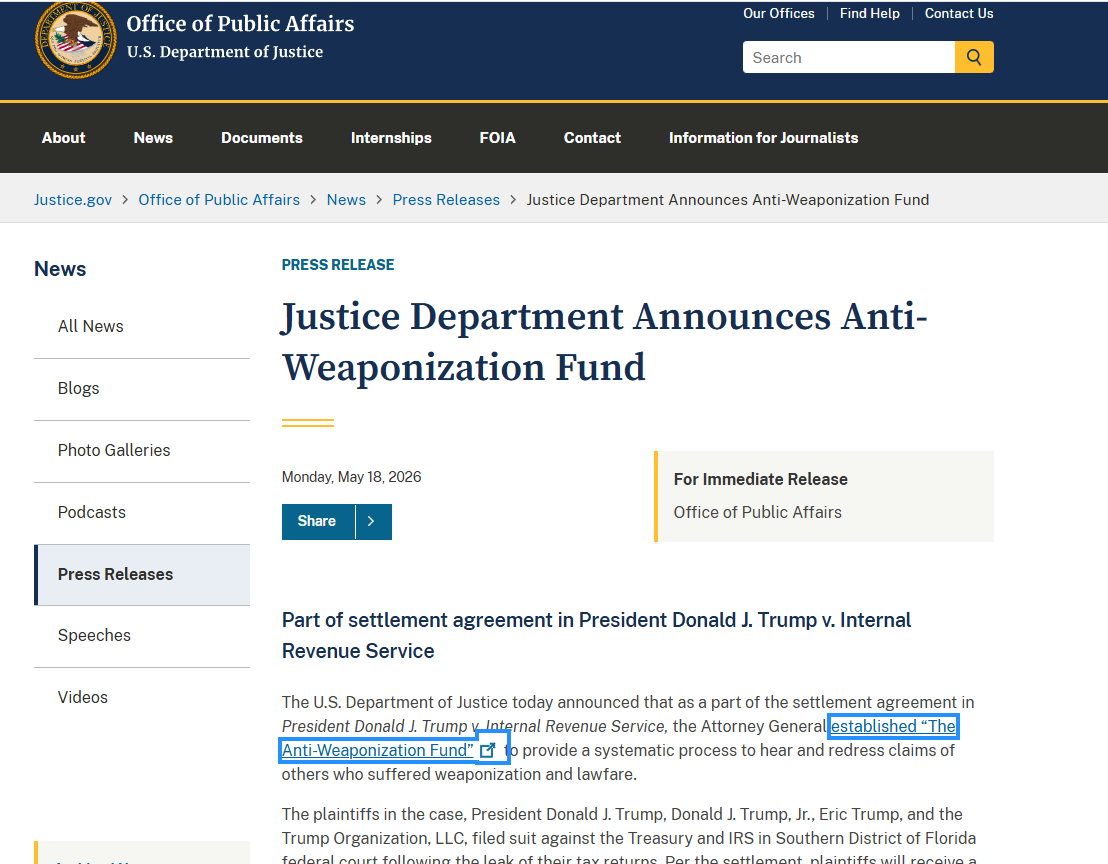
A few hours ago, the Department of Justice announced that it was settling the case between the President and the IRS. The timing, naturally, is immaculate. One suspects the announcement arrived mere moments before the Judiciary was preparing to inform the President of an awkward constitutional reality: namely, that a man cannot plausibly present himself as the aggrieved plaintiff while simultaneously commanding the very executive departments tasked with compensating him for his alleged suffering. Even in modern America’s carnival jurisprudence, there are limits to how vigorously one may sue oneself and then demand the Treasury cut the check.
So the matter, conveniently, has been “resolved.”
In exchange for dropping the suit, the Acting Attorney General now proposes the creation of an “Anti-Weaponization Fund” — a title so grotesquely Orwellian it might embarrass a mid-level apparatchik in a declining Soviet republic. The fund, we are told, will marshal roughly $1.8 billion to compensate the President, his retainers, his flatterers, assorted loyalists, convicted felons whose sentences he commuted, and the various patriotic hysterics who attempted, in one of the more idiotic episodes in American political history, to overturn the government of the United States by storming the Capitol in search of the Vice President, the Speaker, and whichever members of Congress they imagined insufficiently obedient.
These are now, apparently, the officially sponsored victims of the Republic.
The memorandum itself reads less like a legal document than the sort of delirious production one expects from a regime entering its late-decadence phase — all grievance, self-pity, and naked patronage wrapped in the sanctimonious vocabulary of justice. It is the language of men who have ceased even pretending that the state exists for any purpose beyond rewarding friends, terrorizing enemies, and laundering vengeance into policy.

Really? So the instant the money lands in a bank account, the Federal Government suddenly washes its hands of the affair entirely? Fascinating doctrine. One had previously assumed that when the President of the United States obtained funds through fraud — a field in which the gentleman possesses a résumé of considerable depth and professional distinction — the government might retain at least a passing interest in safeguarding public money from being vacuumed into the furnace of his various schemes, collapses, and legal catastrophes.
Apparently not.
Apparently, once the transfer clears, the Republic shrugs, lights a cigarette, and says, “Well, best of luck to everyone involved.”
An especially amusing flourish arrives when the Acting Attorney General, evidently sensing that the whole performance reeks of corruption so strongly that even the walls may soon require fumigation, attempts a defense familiar to every declining regime and drunken ward politician in history:
“Yes, but Obama.”
Observe the intellectual majesty of it. Not a legal defense. Not a constitutional defense. Not even a coherent ethical defense. Merely the ancient cry of the bureaucratic hack caught rummaging through the till: Well the other guy was crooked too.
And then, because modern American politics is incapable of resisting the instincts of a seventh-grade lunchroom argument, comes the final embellishment: Obama was bad, we are better, therefore this particular patronage scheme — this public distribution of money to loyalists, cronies, pardoned hooligans, and political shock troops — is not corruption at all, but somehow a higher and more enlightened species of it.
One begins to appreciate why empires eventually collapse into parody before they collapse into ruin.
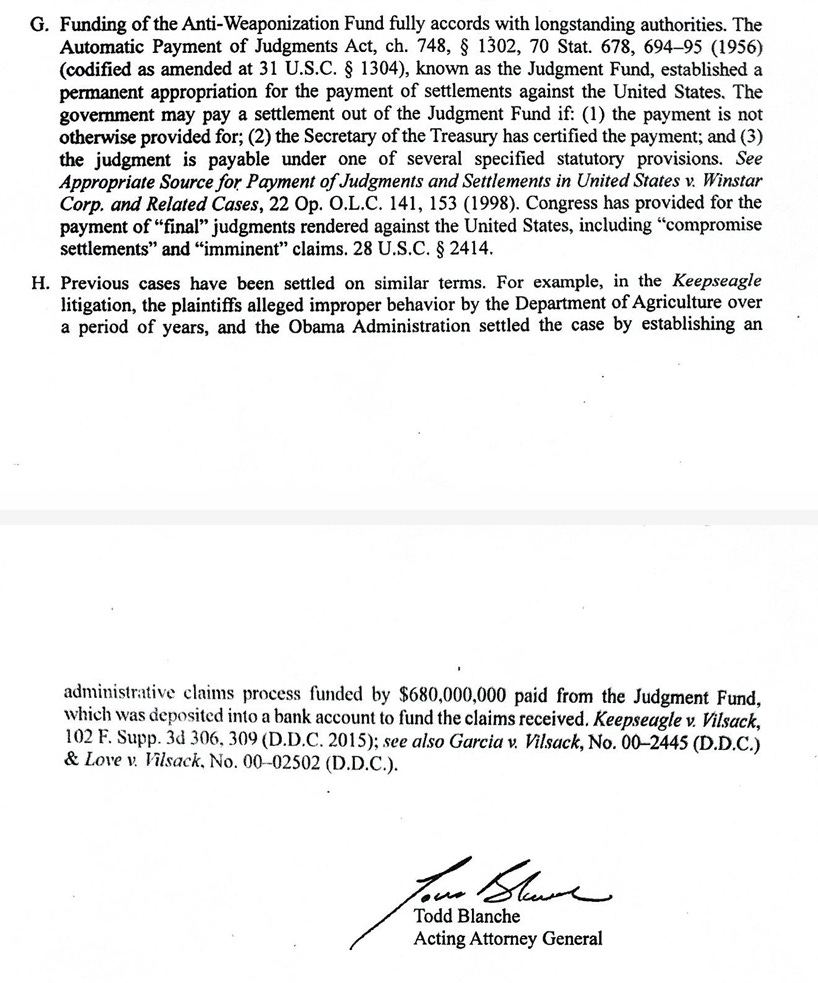
Keepseagle v. Vilsack was a landmark class-action lawsuit against the United States Department of Agriculture alleging decades of systemic discrimination against Native American farmers and ranchers in USDA lending programs. The allegation was neither exotic nor difficult to understand: Native farmers were routinely denied loans, delayed loans, reduced loans, harsher terms, and servicing assistance that white farmers received as a matter of administrative muscle memory. The discrimination allegedly stretched from roughly 1981 through 1999 and left entire Native agricultural communities economically crippled.
After eleven years of litigation — and with the Federal Government facing the increasingly unpleasant possibility of eventually losing on the merits — the Obama Administration settled in 2010 for up to $760 million: roughly $680 million in cash compensation and another $80 million in loan forgiveness. Importantly, the money came through the Treasury Judgment Fund, thereby avoiding the congressional circus that had already stalled parallel relief for Black farmers under Pigford v. Glickman and its sequel. In plainer English: Congress had all the enthusiasm of a cemetery for compensating minority farmers, so the Administration used an available legal mechanism to end the litigation without waiting for Capitol Hill to rediscover civilization.
But the settlement was not merely a giant sack of money tossed from a government wagon. It included structural reforms: advisory councils, technical assistance, tribal sub-offices, and review mechanisms for USDA loan programs. The point was remediation of an actual, documented institutional failure.
And even then, the money became contentious.
The claims process yielded thousands of approved claimants, but hundreds of millions remained undistributed. Under the settlement’s cy pres provisions, leftover funds were directed toward nonprofits serving Native American agricultural communities. Predictably, disputes erupted over whether the money should instead be distributed directly to prevailing claimants. The lead plaintiffs themselves eventually split from class counsel and fought over the disposition of the remaining funds. Courts intervened. Modifications were negotiated. More distributions occurred. Ultimately, a substantial remainder was directed into the Native American Agriculture Fund to support Native agriculture over two decades.
In other words: this was the messy but recognizable anatomy of an actual civil-rights settlement after a decade of litigation over genuine discriminatory conduct.
It was not a presidential patronage machine.
It was not a loyalty-rewards program for pardoned political foot soldiers.
It was not a public treasury repurposed into a compensation fund for cronies, seditionists, and useful idiots who attempted to overturn an election and then received absolution from the same political figure now positioned to benefit from the payout architecture.
Yet now we are invited to pretend these things are comparable because somewhere, somewhere, in the distant legal fog, both situations involve the phrase “settlement fund.”
Marvelous.
And one need not possess a particularly vivid imagination to see where this sort of mechanism could drift under sufficiently shameless management. Today it is “victims of weaponization.” Tomorrow it becomes allied nonprofits, presidential libraries, trusts, foundations, legal-defense entities, advocacy groups, consulting vehicles, or whichever glorified grift receptacle happens to be politically fashionable among the ruling court eunuchs of the moment.
One billion here. Several hundred million there. Soon enough, the whole thing begins to resemble less a justice system than a state-sponsored rewards program for political loyalty.
And this is where the comparison to Shakespeare becomes darkly amusing.
In Henry VI, Part 2, the famous line — “The first thing we do, let’s kill all the lawyers” — is spoken not by defenders of liberty, but by conspirators seeking tyranny. The lawyers are obstacles because they preserve structure, process, continuity, and inconvenient reality. They are barriers between ambition and naked power.
But modern institutional decay produces its own inversion. When lawyers cease defending the rule of law and instead become technicians of rationalized corruption — men whose sole professional purpose is laundering appetite into procedure — then they no longer stand athwart corruption. They become its architecture.
And that, perhaps, is the most corrosive feature of all this: not merely the corruption itself, but the transformation of institutions once designed to restrain power into mechanisms designed to legitimize it after the fact.
I wrote about this, Bryan, a couple days ago — before it became “breaking news” that will be poorly explained to most Americans.
Not that it shows any genius on my part, just what any casual observer of decades of liars, crooks, and cheaters should have seen coming.
https://citizen99.substack.com/p/congratulations-you-are-about-to?r=2sauq&utm_medium=ios
This country is absolutely fucked. And that's why I'm working on my Canadian Citizenship by Descent application. I want an escape hatch from the Trump Reich.